
Keyword research in 2026 is quite different from what it used to be a few years ago. Search engines are smarter, and your content just can’t rank with keyword stuffing. Targeting just high search volume keywords without understanding the actual needs of your audience is not going to work in the coming years. User behavior is also changing, and they now look for more specific answers rather than generic keyword-stuffed information.
To keep up with this fast-changing world of digital marketing, you must shift your focus from just traditional SEO to AI SEO. There are plenty of AI-powered SEO and keyword research tools available in the market. If you know how to leverage them correctly, you can stay ahead of the competition and make your brand shine.
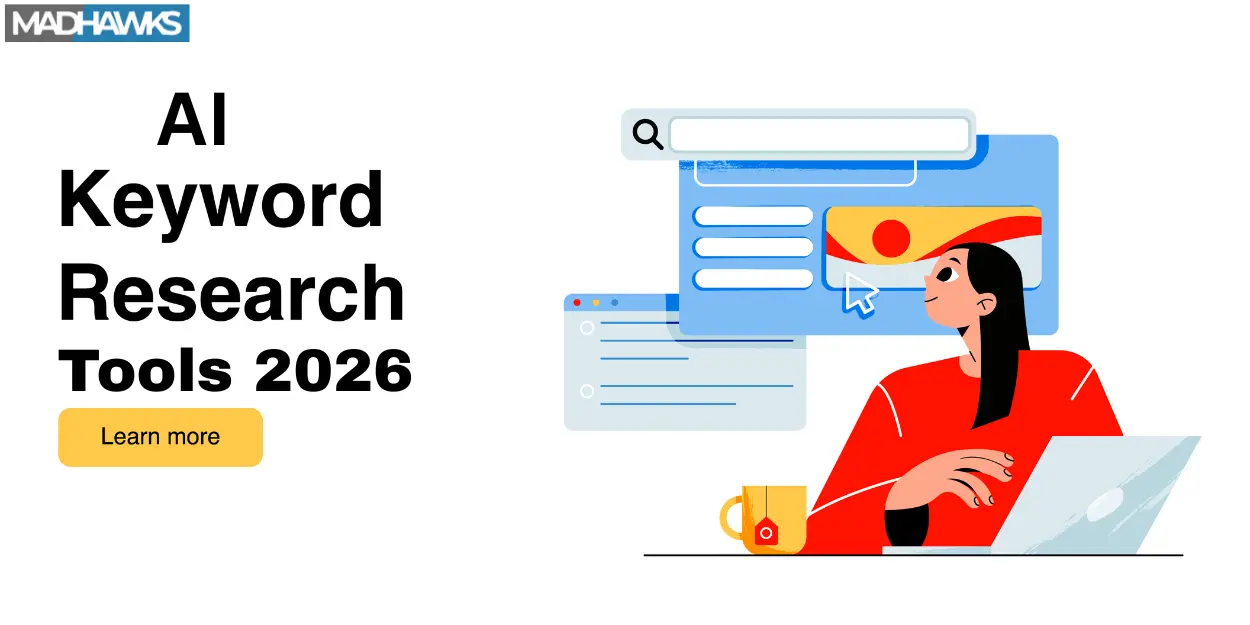
AI has entered almost every part of SEO, including keyword research, which is the first step of any SEO optimization strategy. Today, it’s not just about finding keywords with high search volume; it’s about understanding search intent, topic analysis, and creating helpful content that actually covers the needs of people. Being one of the top AI SEO agencies in India, MadHawks has tried and tested various keyword research tools. Here is a list of some top ones that you may consider for AI keyword research in 2026:
1. Google Keyword Planner
Google Keyword Planner continues to be one of the most reliable tools since it uses real Google search data. Be it ad planning or organic SEO, Keyword Planner helps validate search volume, competition, and keyword relevance. Although it may not be able to provide deep insights, it’s perfect for checking the actual demand for a keyword before targeting it.
The tool uses AI and Machine Learning to generate keyword ideas, predict performance, and perform other key functions. You can see if people are really searching for a particular keyword currently, or it has gone out of trend. As this tool is free to use, it stays at the top of the list for keyword research and AI SEO optimization.
2. SEMrush Keyword Magic Tool
If there is one tool that almost every AI SEO services company uses, that is definitely SEMrush. SEMrush is one of the most reliable and powerful SEO platforms out there. The Keyword Magic Tool by SEMrush gives access to a huge database of keywords with filters for intent, match type, and difficulty. You can put these filters to thoroughly analyze keywords and make your AI SEO strategy stronger. It also groups keywords into clusters, making it easier to build topic-wise content. For competitive industries, SEMrush can provide detailed SERP analysis and help you identify competitor keyword gaps.
3. Ahrefs Keywords Explorer
Ahrefs is another very popular tool used by all the top AI SEO agencies in India, including MadHawks. The tool is known for its precise keyword-related data and keyword difficulty scoring. The tool, Keywords Explorer by Ahrefs, gives you thorough information about what people click on, how hard it is to rank, and what kind of content already exists on the page. You learn to target keywords that can actually bring in traffic instead of focusing entirely on their volume.
4. Moz Keyword Explorer
Moz provides a clean, friendly interface that works well for beginners. Perhaps one of the greatest features is the Priority Score. It is a number that combines volume and competition with importance to create a singular number. This makes it so much easier for content teams to pick the right keywords without getting confused by too many metrics.
5. AnswerThePublic
AnswerThePublic is a lesser-known, but highly relevant tool for AI SEO today. It can help you find out what type of questions people are actually asking in a particular niche or industry. This tool gives you a list of question-based and conversational keywords related to a particular topic. You get a list of plenty of questions in one place and answer those in your content for your content to be found by the audience online. It shows what people are asking online using real search behaviour patterns. For blogs, FAQs and voice-search optimization, AnswerThePublic is the perfect tool.
6. Ubersuggest
Ubersuggest is an easily accessible and affordable tool that offers keyword ideas, SEO difficulty, content suggestions, and insights into traffic. It can be used by freelancers, small businesses, and beginners because it’s pretty simple and doesn’t require high costs. While the data may not be as deep compared to SEMrush or Ahrefs, it gives enough insights to build a content plan. If you are looking for a medium-level AI SEO or keyword research tool as a beginner, you can consider this one.
7. ChatGPT for Keyword Research
ChatGPT has become an important part of keyword research because it uses advanced AI to generate topic ideas, long-tail keywords, semantic clusters, and content gaps. You can simply give your website URL to this tool, and it will give a full-fledged strategy on what more you can do to improve your rankings. It can also analyze competitor pages, group keywords, and suggest content structures. It’s faster, more creative, and perfect for brainstorming new keyword ideas. Also, it’s ease of use makes it a preferred choice for many.
8. KW Finder (Mangools)
KW Finder is a favourite for discovering low-competition and long-tail keywords. The interface is clean, the difficulty score is reliable, and the suggestions are practical. It’s especially useful for new websites or niches where you want to target easy-to-rank keywords and build traffic steadily.
9. Jasper (AI SEO Mode)
Jasper is known for content generation, but its SEO mode also helps in keyword expansion and clustering. It reads SERPs, suggests related keywords, and prepares content-ready keyword lists. For content creators who want keyword suggestions along with AI writing support, Jasper works very well.
10. Keyword Insights
It’s one of the best keyword clustering tools in 2026. This clusters keywords based on how Google interprets them on the SERP, helps you avoid keyword cannibalisation, and makes sure that each page targets a unique intent. Keyword Insights also prepares content briefs and intent tags, making it very easy to create a strong content strategy.
Concluding Thoughts
Keyword research in 2026 is no longer about running behind big numbers but choosing the right keywords for the right user intent. Combining reliable tools such as Google Keyword Planner, SEMrush, and Ahrefs with AI tools like ChatGPT, Jasper, and Keyword Insights can bring in a powerful keyword strategy that gives you real results. Whether you’re a beginner, an SEO professional, or an AI SEO services agency, using a mix of traditional and AI tools will help you stay ahead in this fast-changing digital world. If you still feel stuck somewhere, feel free to get in touch with MadHawks SEO experts!
Also read this blog:– AI-Powered Keyword Research
FAQs
Q. How do AI keyword research tools differ from traditional SEO tools?
A. AI keyword research tools use AI and Machine Learning capabilities to perform tasks faster and analyze data more thoroughly, unlike traditional tools that used to have limited abilities.
Q. What criteria should I use to evaluate AI keyword research tools in 2026?
A. To evaluate an AI keyword research tool in 2026, you should look at its AI capabilities, features, accessibility, ease of use, and affordability.
Q. Are AI keyword research tools reliable for finding low-competition keywords?
A. Yes, AI keyword research tools can be very helpful in finding low-competition keywords that are more specific and easier to rank for.